Skip to content

Benchmark Results

This page records the current checked benchmark artifacts. It is a results snapshot, not a marketing leaderboard and not a replacement for the underlying JSON artifacts. Read it as a guide to what the repo can prove today, what is only diagnostic, and which claim gates still need external evidence.

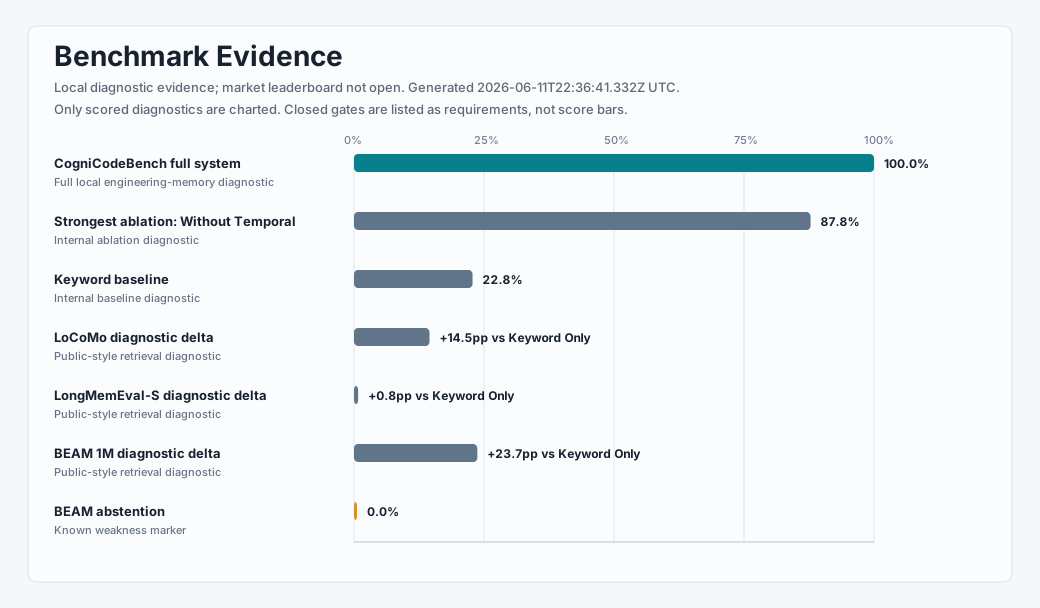
Benchmark result charts

Reality Bench / EMRP v1

Reality Bench is the Engineering Memory Reality Protocol v1 (emrp-v1). It is the flagship protocol for repeated-mistake prevention, stale-rule suppression, forbidden-action blocking, patch evidence, source-cited recall, deletion/privacy boundaries, abstention, and public memory QA. Its public output is artifacts/public/evidence-table/ until the strict market gate passes.

The gate requires a frozen manifest, retained raw outputs, the same input stream, the same budgets, the same judge, Cognibrain plus at least two original competitor implementations, public artifact hash, and independent replication hash. Capability-profile adapters are explicitly blocked from public comparison claims.

How To Read This Page

Benchmark rows in this repo are deliberately strict. A high local score means "this implementation passed this checked diagnostic." It does not automatically mean "best product on the market" or "quality proven against every competitor."

The practical reading order is:

  1. Read Market Readiness Summary for the human headline.
  2. Read What You Can Safely Say before using any result in public copy.
  3. Use Reproduce The Main Proof Surface when you need fresh local evidence.
  4. Use Artifact Snapshot and the detailed sections when you need exact generated-file provenance.
Label Plain meaning Allowed claim
local-diagnostic The repo ran a deterministic or local harness successfully. Useful regression evidence for Cognibrain itself.
diagnostic-public-benchmark-baseline Cognibrain was stressed on public-style data or local baselines. Retrieval signal only; not a market comparison.
neutral-blackbox-smoke The harness can run a frozen manifest and preserve raw outputs. Harness readiness; quality remains unscored without a judge.
claimAllowed=false The artifact intentionally blocks stronger claims. Do not use it as market or quality proof.
qualityClaimAllowed=true A configured judge or equivalent proof gate accepted the result. The specific quality claim described by that artifact.
marketClaimAllowed=true Same-protocol competitor proof and market gates passed. A bounded market comparison for that exact protocol.

The short interpretation: Cognibrain has strong engineering-memory diagnostics and unusually explicit proof boundaries. Independent market leadership remains blocked until judged original competitor runs, public hashes and replication exist.

What You Can Safely Say

Use this page to keep public language tight:

Safe statement Why it is safe Stronger statement to avoid
Cognibrain has strong local diagnostics for coding-agent memory workflows. Product truth, plan, CogniCodeBench, Arena and public dataset stress artifacts are checked in the current proof surface. Cognibrain is the best memory product overall.
The benchmark pages separate diagnostic evidence from market proof. Rows carry proof labels such as local-diagnostic, claimAllowed=false, qualityClaimAllowed and marketClaimAllowed. Every high score is a market claim.
The real-world harness is ready to retain raw outputs and telemetry. The frozen protocol, raw-output capture and latency/cost fields exist. The real-world harness already proves quality leadership.
Public dataset rows show retrieval stress signals. LoCoMo, LongMemEval-S and BEAM rows compare against local baselines. Public dataset rows prove answer quality or competitor superiority.

The useful product story is: Cognibrain is built to stop coding agents from repeating known engineering mistakes, and this repo carries local proof for that loop. The blocked story is: Cognibrain has not yet published a fair, independently replicated market leaderboard against original competitor systems.

Reproduce The Main Proof Surface

For a normal maintainer check, start here:

npm test
npm run build
npm run release:check

For proof-specific refreshes:

npm run internal -- audit:truth
npm run internal -- audit:plan-gaps
npm run internal -- audit:latest-analysis
npm run internal -- proof:plan

For benchmark artifacts, use the specific commands in the maintainer refresh map below. Generated outputs belong under artifacts/; review them as evidence, but do not turn them into broader claims unless their claim gates allow it.

Benchmark Families

Family What it answers What it does not answer
Product truth and plan audits Do README/docs/status claims match current code and artifacts? Whether customers have deployed the system successfully.
CogniCodeBench Can Cognibrain retrieve and use engineering memory across synthetic repo-like scenarios? Whether it beats external products on a neutral public protocol.
Public dataset stress Does retrieval improve over local keyword baselines on LoCoMo, LongMemEval-S and BEAM-style tasks? Whether answer quality or market leadership is proven.
Real-world black-box harness Can a frozen manifest, raw outputs, telemetry and competitor slots be captured fairly? Quality scoring before the LLM/harness judge and original competitor commands are configured.
Arena and operator-memory diagnostics Do internal capability profiles, ablations and source-aware dream paths regress? Production tenant certification or independent leaderboard ranking.

Maintainer Refresh Map

Use these commands when the checked result surface needs to be refreshed. They write generated outputs under artifacts/; those outputs are local review evidence and are not shipped as source documentation.

Need Command
Documentation claim audit npm run internal -- audit:docs
Product truth audit npm run internal -- audit:truth
Plan and latest-analysis proof npm run internal -- audit:plan-gaps and npm run internal -- audit:latest-analysis
CogniCodeBench run npm run internal -- benchmark:cognicode
Arena run npm run internal -- benchmark:arena
Real-world black-box smoke npm run internal -- benchmark:realworld:blackbox
Benchmark chart npm run internal -- benchmark:svg
Release gate npm run release:check

Market Readiness Summary

The current artifacts support a professional engineering-memory claim: Cognibrain has strong local diagnostics for coding-agent context, guard and patch-evidence workflows, and the repo has explicit proof gates that block overstated market claims.

In one sentence: the repo currently proves a serious local engineering-memory system with strong regression diagnostics, while deliberately blocking unearned market-leadership claims.

What is currently strong:

  • Product truth audit: 69/69 checks passed, 0 open code-truth gaps.
  • Plan closure: 16/16 plan-gap checks, 10/10 latest-analysis checks and 10/10 full-plan proof checks.
  • CogniCodeBench: 1,000 scenarios, 100.0% full-system diagnostic score and 96.0% integrity score.
  • Real-world black-box harness: coverage, raw-output retention and telemetry are ready for judged runs.

What is not yet claimable:

  • No overall "best memory solution on the market" claim.
  • No public leaderboard claim until original competitor systems are judged on the same frozen protocol.
  • No BEAM quality claim: BEAM artifacts are useful diagnostics, but their pass gates are currently false and qualityClaimAllowed=false.

Use the detailed sections below as the evidence register behind those three sentences. They are intentionally more precise than marketing copy because each row needs to preserve its proof boundary.

Artifact Snapshot

Artifact Generated Result
artifacts/nextgen-benchmarks.json 2026-06-05T17:00:26.697Z Diagnostic pass; local lifecycle fixture checks are not quality or market proof
artifacts/cognicodebench/run.json 2026-06-09T10:39:45.075Z Passed
artifacts/arena/run.json 2026-06-09T10:42:05.746Z Passed
artifacts/arena/native-competitors.json 2026-06-01T08:53:30.159Z Recorded; native smoke evidence is still bounded by proof level
artifacts/answer-generation.json 2026-06-05T17:03:23.002Z Diagnostic pass unless generated with a successful external LLM/harness judge; deterministic coverage is not answer-quality proof
artifacts/leaderboard.json 2026-06-09T10:42:29.634Z Diagnostic publication; local deterministic entries are not quality or market proof
artifacts/benchmark-hardening.json 2026-06-09T10:42:28.349Z Passed
artifacts/external-hard-summary.json 2026-06-02T17:35:55.221Z Diagnostic pass; claimAllowed=false until all child rows carry LLM/harness or comparable public-benchmark proof
artifacts/original-public-benchmarks.json 2026-06-02T09:05:43.612Z Partial: upstream LongMemEval BM25 and Basic Memory full benchmark marker suite passed; Mem0 exact upstream is blocked by stale dependency ref
artifacts/realworld-benchmark-protocol.json 2026-06-09T10:37:25.334Z Protocol ready; current artifacts are classified, but 0 are fair market-wide leaderboard evidence
artifacts/realworld-blackbox.json 2026-06-09T10:37:19.743Z Neutral harness ready with coverage gates, raw outputs and telemetry; quality not scored because the LLM/harness judge and external competitor commands are blocked
artifacts/realworld-blackbox-openai-intelligence.json 2026-06-05T17:03:20.930Z Controlled blocked-judge rerun; raw outputs retained, strict judge-contract validation active, and no current quality score is reportable
artifacts/realworld-blackbox-openai-intelligence-success.json not generated Last-successful judged smoke slot; only updated by scoreable LLM/harness runs
artifacts/external-basic-memory.json 2026-06-01T12:37:07Z Adapter diagnostic, not an original benchmark
artifacts/locomo-report.json 2026-06-02T18:25:38.418Z Diagnostic pass; local evidence-id recall is not quality or market proof
artifacts/longmemeval-report.json 2026-06-02T18:30:16.433Z Diagnostic pass; local session-id recall is not quality or market proof
artifacts/beam-report.json 2026-06-05T11:21:22.180Z Diagnostic signal; pass gate false; local BEAM rubric-support scoring is not quality or market proof
artifacts/beam-500k-report.json 2026-06-05T11:28:47.320Z Diagnostic signal; pass gate false; local BEAM rubric-support scoring is not quality or market proof
artifacts/beam-1m-report.json 2026-06-05T11:41:15.784Z Diagnostic signal; pass gate false; local BEAM rubric-support scoring is not quality or market proof

Public Benchmark Dataset Stress

These rows are Cognibrain runs against public-style datasets and local baselines. They are useful regression evidence, but they are not original product runs for other memory systems and are not a fair market leaderboard.

Dataset Metric Proof Claim Cognibrain Strongest local baseline Status
LoCoMo Evidence recall@K local-diagnostic Blocked 57.9% (890/1536) Keyword only 43.4% Diagnostic pass
LongMemEval-S Answer-session recall@K local-diagnostic Blocked 99.8% (499/500) Keyword only 99.0% Diagnostic pass
BEAM 100K Retrieval nugget score@K beam-rubric-support-diagnostic Blocked 46.0% (184/400) Keyword only 28.2% Diagnostic signal; pass gate false
BEAM 500K Retrieval nugget score@K beam-rubric-support-diagnostic Blocked 43.4% (304/700) Keyword only 22.6% Diagnostic signal; pass gate false
BEAM 1M Retrieval nugget score@K beam-rubric-support-diagnostic Blocked 51.3% (359/700) Keyword only 27.6% Diagnostic signal; pass gate false

Benchmark Integrity

Signal Result
CogniCodeBench integrity score 96.0% diagnostic
CogniCodeBench overfit risk Low
Scenario leakage No open weakness
Patch realism Proposal-stage evidence, no direct expected-action injection
Baseline separation No open weakness; strongest ablation 87.8%

BEAM Weaknesses

Split Weakest categories Improvement signal
100K Abstention 0.0%, instruction following 12.5%, temporal reasoning 20.0% Add unsupported-question gating, stronger instruction-evidence scoring, and temporal normalization.
500K Abstention 0.0%, temporal reasoning 17.1%, knowledge update 22.9% Reduce plausible-but-unsupported retrieval and improve fresh fact/version evidence.
1M Abstention 0.0%, temporal reasoning 21.4%, knowledge update 24.3% Treat abstention and temporal/freshness retrieval as the next benchmark-driven workstream.

Claim Boundaries

Benchmark claims on this page are limited to the checked artifacts listed above. Older or stronger rows are not carried forward without a current artifact. The SVG chart is bounded the same way: public dataset, Arena and ablation bars display proof or diagnostic status, and local/API-shape/ablation diagnostics are marked claim-blocked or not-market-proof instead of being shown as market or quality proof. The public leaderboard.json artifact now marks local fixture and deterministic coverage scores as claimAllowed=false diagnostic rows; quality claims require LLM/harness proof, and market comparisons require comparable public benchmark artifacts. The nextgen-benchmarks.json lifecycle suite is also diagnostic-only: its deterministic fixture, structural and harness-review checks validate local regressions, but the artifact carries qualityClaimAllowed=false and marketClaimAllowed=false until judged by an external LLM/harness or backed by comparable public-benchmark proof. Answer-generation artifacts carry the same boundary at the raw artifact layer: deterministic extractive answers and expected-term coverage are diagnostic-only, configured judge-command failures fail closed, and qualityClaimAllowed=true is emitted only when every question has a successful external LLM/harness judge contract result. The real-world protocol currently classifies 0 checked artifacts as fair cross-system leaderboard evidence. The current LLM-intelligence artifact is judge-blocked and intentionally reports no quality score. It retains same-manifest raw outputs for Cognibrain, Basic Memory and LangMem so retrieval weaknesses remain inspectable while the LLM/harness judge is unavailable. Arena external command runners follow the same boundary: runner-provided checks are diagnostic only unless MEMORY_ARENA_JUDGE_COMMAND validates the raw product evidence into strict boolean checks. Operator Memory native competitor runners are bounded the same way: runner checks are ignored for scoring unless MEMORY_OPERATOR_MEMORY_JUDGE_COMMAND validates raw source-aware evidence into strict boolean checks. The public-dataset market-gate now follows this too: local LoCoMo, LongMemEval or BEAM recall wins are diagnostic-public-benchmark-baseline unless every included benchmark artifact carries LLM/harness or comparable public-benchmark proof. The legacy synthetic retrieval report is also diagnostic-only: its expected-id substring scorer is useful for regression smoke tests, but claimBoundary marks quality and market claims as blocked until an LLM/harness judge or comparable public-benchmark proof is present. The individual local LoCoMo and LongMemEval artifacts carry the same claimBoundary: evidence/session-id recall remains useful retrieval diagnostics, not answer-quality or market-comparison proof, until an LLM/harness judge or official same-protocol public artifact is attached. External-hard public dataset stress is diagnostic-only for the same reason: even when all stricter-budget rows improve over local baselines, claimAllowed=false unless every child artifact is scoreable with LLM/harness or comparable public-benchmark proof. BEAM raw artifacts now carry this boundary directly: deterministic rubric, entity and evidence-support scoring is local-diagnostic, and passed=true is reserved for runs backed by MEMORY_INTELLIGENCE_COMMAND or an equivalent LLM/harness evidence judge.

Real-World Fairness Boundary

The current real-world protocol artifact is a preregistration and evidence classifier, not a score table. A result is leaderboard-eligible only when the dataset, prompts, scoring, budgets, and adapter contract are frozen before system tuning; every system receives the same input stream; every system runs through its original package, CLI, SDK, service, or official API; and raw outputs, cost, latency, versions, errors, and scorer traces are retained. Market leaderboard eligibility also requires a public immutable artifact hash for the exact judged run, an independent replication artifact hash, a third-party protocol with at least 30 tasks, and preregistered latency/cost budgets for the judge and attached systems.

Current artifact classes:

Artifact Evidence class Leaderboard eligible Why
artifacts/realworld-blackbox.json neutral-blackbox-smoke No Same frozen manifest, raw outputs and latency/cost fields, but quality scoring is blocked until MEMORY_REALWORLD_JUDGE_COMMAND and external competitor commands are configured.
artifacts/realworld-blackbox-openai-intelligence.json llm-intelligence-neutral-smoke No The current rerun reached the same frozen manifest and original-system commands, retained raw outputs, and blocked quality scoring because the configured judge failed.
artifacts/realworld-blackbox-openai-intelligence-success.json llm-intelligence-last-successful-judged-smoke No Separate last-successful slot; credential-blocked latest attempts must not overwrite scoreable judged evidence.
artifacts/original-public-benchmarks.json upstream-original-evidence No Original upstream evidence and blockers, but not all systems on one neutral protocol.
artifacts/external-hard-summary.json cognibrain-public-dataset-stress No Cognibrain versus local baselines, not original competitor product runs.
artifacts/arena/run.json cognibrain-designed-adapter-diagnostic No CogniCode scenarios and capability-profile adapters are Cognibrain-shaped.
artifacts/arena/native-competitors.json native-smoke-on-cognibrain-designed-scenarios No Some native paths run, but the scenario family is still Cognibrain-designed.
artifacts/external-basic-memory.json custom-adapter-diagnostic No Basic Memory is run through a local adapter, not an official or preregistered generic adapter.
artifacts/cognicodebench/run.json internal-product-benchmark No Strong internal regression suite, not a neutral cross-system benchmark.

Real-World Black-Box Smoke

This is the first neutral harness implementation. It uses a frozen realworld-blackbox-v1 manifest and a generic reset, ingest, query, export-raw-outputs, teardown contract. It records raw outputs, setup blockers, latency percentiles and cost fields. The current manifest coverage gate requires at least 15 queries, at least 3 queries per task bucket, and at least 3 abstention/privacy/deletion queries before the smoke can be considered coverage-ready. Score, recall, abstention and leakage quality metrics stay not scored until MEMORY_REALWORLD_JUDGE_COMMAND points to a fixed LLM/harness judge. Structured evidence-id matches are diagnostics only; they are not quality scores and are not leaderboard proof. The checked LLM path is scripts/benchmark/realworld-openai-judge.mjs, which passes retrieved text rather than retrieved evidence IDs to the judge. Judged runs are fail-closed: the harness requires exactly one decision for every manifest query, no unknown or duplicate query IDs, finite 0..1 score and confidence values, strict JSON booleans for decision fields, and finite latency/cost metrics from external command runners. Malformed judged outputs retain raw retrieval outputs but are not quality-scored or leaderboard-eligible. Configured original-system command failures are separated from missing credentials: non-zero exits, invalid JSON, and missing judged raw-output shapes are classified as same-run-command contract diagnostics with no quality score, not as credential-blocked rows. It is still not a leaderboard because the default no-score artifact has no LLM/harness judge command or original competitor commands configured.

System Evidence class Judge Score Recall Abstention Leakage p95 latency Boundary
Cognibrain same-run-full missing:blocked not scored not scored not scored not scored 12 ms Real local product run, but quality claims are blocked until an LLM/harness judge scores the retained raw outputs.
Keyword baseline local-baseline missing:blocked not scored not scored not scored not scored 1 ms Baseline only, never a product-system leaderboard row.
Mem0, Basic Memory, LangMem, Graphiti, Zep, Cognee, GBrain credential-blocked missing:blocked not scored not scored not scored not scored 0 ms Missing MEMORY_REALWORLD_*_COMMAND runner commands in the no-score default run.

Immediate Cognibrain raw-output diagnostics: support queries can retrieve an unrelated decoy alongside the correct evidence; temporal-update queries can retrieve stale and current evidence together; deleted-token abstention can still retrieve unrelated support facts instead of returning no evidence. These signals define the next retrieval work, but they are diagnostics only until the LLM/harness judge scores them.

LLM-Intelligence Retrieval Smoke

This separate smoke run configures MEMORY_INTELLIGENCE_COMMAND with scripts/benchmark/openai-memory-intelligence.mjs and scores delivered outputs with scripts/benchmark/realworld-openai-judge.mjs. It keeps raw diagnostics for excluded candidates but passes only non-excluded delivered text to the quality judge. The current checked rerun is judge-blocked, so the rows below are not quality scores; they are raw-output and latency diagnostics.

System Retrieval intelligence Judge Score Recall Abstention Leakage p95 latency Boundary
Cognibrain OpenAI-compatible JSON command missing:blocked not scored not scored not scored not scored 10 ms Same-run full product raw outputs retained; quality blocked until the LLM/harness judge succeeds.
Basic Memory Original basic-memory==0.21.5 local package, CLI reindex, MCP search_notes missing:blocked not scored not scored not scored not scored 776 ms Original package command raw outputs retained; quality blocked until the LLM/harness judge succeeds.
LangMem Original langmem==0.0.30 package with langgraph.store.memory.InMemoryStore and upstream memory tools missing:blocked not scored not scored not scored not scored 0 ms Original package command raw outputs retained; quality blocked until the LLM/harness judge succeeds.
Keyword baseline None missing:blocked not scored not scored not scored not scored 0 ms Baseline only; current judge blocked.

The current improvement in code is the provider path, not a fresh market score: JSON-command intelligence calls now use compact result payloads and a bounded short-lived response cache, so repeated semantic LLM/harness judgements do not pay duplicate process and provider cost. This keeps retrieval intelligence provider-driven while targeting the previous latency weakness. Provider evidence is also fail-closed at the memory level: answerable=true alone does not authorize delivery, the top-level verdict must carry strict boolean answerable and finite 0..1 confidence fields, and every returned memory must have an explicit per-memory LLM/harness decision with finite 0..1 confidence before it can enter injected context; malformed answerable provider output is converted to excluded evidence rather than calibrated from heuristics. Direct harness decisions must use valid decision values, no unknown or duplicate memory ids, and retrieval calibration preserves earlier unsafeToInject flags instead of overriding them. The real-world Cognibrain adapter applies the same delivery boundary: review-gated or otherwise unsafeToInject retrieval results stay in raw diagnostics but are not exported as delivered retrievedText for the quality judge. External original-system runners are also fail-closed against the frozen manifest: raw outputs must contain exactly one output for every query id, no unknown or duplicate query ids, finite latency values, and no more than the query topK returned text/evidence items. Cost and latency gate fields must be finite non-negative numbers; malformed metric fields keep raw diagnostics but do not pass the cost/latency eligibility gate. The harness now also separates latest-attempt artifacts from the last successful judged artifact so credential failures do not erase scoreable scientific evidence, and it keeps same-manifest raw outputs when judge failures happen after retrieval. The current artifact also records judge and command fingerprints without raw command values, and redacts diagnostic blocked reasons before writing them.

CogniCodeBench

Metric Result
Scenarios 1000
Correction carry-over 100.0%
Repeated mistake rate 0.0%
Procedure recall 100.0%
Patch correctness 100.0%
Evidence completeness 100.0%
Wrong-memory suppression 100.0%
Source-reference correctness 100.0%
Granular patch correctness 100.0%
Long-horizon recall 100.0%

Diagnostics: integrity 96.0%, overfit risk low. The current run reports no open CogniCodeBench design weaknesses: task-prompt leakage is low, patch evidence is generated through a proposal stage instead of direct expected-action injection, and the strongest internal ablation remains below the full system.

Claim boundary: the current CogniCodeBench run is proof=local-diagnostic, qualityClaimAllowed=false, and marketClaimAllowed=false. Local scenario checks, ablations, leakage diagnostics, and synthetic patch checks remain diagnostic-only unless an external MEMORY_COGNICODEBENCH_QUALITY_JUDGE_COMMAND LLM/harness judge validates the full report.

Baselines

Baseline Score Repeated mistake rate
No memory 0.0% 100.0%
Raw chat history 0.0% 100.0%
Vector only 1.7% 100.0%
Semantic only 1.7% 100.0%
Keyword only 22.8% 75.0%
Graph only 18.9% 85.0%
Temporal only 3.3% 95.0%
Procedure only 36.6% 90.0%
Cognibrain without temporal 87.8% 0.0%
Cognibrain without corrections 15.5% 90.0%

Arena

This is a Cognibrain lifecycle diagnostic, not a fair real-world leaderboard. Rows with api-shape proof levels are capability models, not original product runs. Arena command runners must return structured JSON checks; raw text output is retained as diagnostic evidence but is not parsed into success scores.

System Proof level Claim status Mode Scenarios Score
Cognibrain same-run-full Local product proof only; not market-wide full-local 300 100.0%
Graphiti/Zep same-run-api-shape Diagnostic model; claim blocked api-shape 300 66.7%
Zep same-run-api-shape Diagnostic model; claim blocked api-shape 300 66.7%
GBrain same-run-api-shape Diagnostic model; claim blocked api-shape 300 66.7%
Cognee same-run-api-shape Diagnostic model; claim blocked api-shape 300 60.0%
Basic Memory same-run-api-shape Diagnostic model; claim blocked api-shape 300 60.0%
Mem0 same-run-api-shape Diagnostic model; claim blocked api-shape 300 15.0%
LangMem same-run-native Judge required for quality claim native-command 300 0.0%

Native Competitor Smoke

This smoke run checks native runner plumbing on Cognibrain-designed scenarios. It can expose setup and adapter weaknesses, but it is not a neutral cross-system result table.

System Proof level Claim status Mode Scenarios Score Repeated mistake rate
Cognibrain same-run-full Local product proof only; not market-wide full-local 30 96.7% 0.0%
Mem0 same-run-native Judge required for quality claim native-command 30 66.7% 100.0%
LangMem same-run-native Judge required for quality claim native-command 30 66.7% 100.0%
GBrain same-run-cli Judge required for quality claim cli-command 30 66.7% 100.0%
Basic Memory same-run-native Judge required for quality claim native-command 30 66.7% 100.0%
Graphiti/Zep credential-blocked No scoreable claim blocked-command 30 0.0% 100.0%
Cognee credential-blocked No scoreable claim blocked-command 30 0.0% 100.0%

External Hard

This diagnostic run uses public datasets with stricter retrieval budgets than the default snapshot. It is intended to expose weak margins, not to replace the standard artifact rows above. These are diagnostic retrieval stress rows, not quality or market claims.

Dataset Metric Cognibrain Strongest baseline Gap
LoCoMo Evidence recall@1, no summaries 35.7% Keyword only 32.2% +3.6%
LongMemEval-S Answer-session recall@1 75.4% Keyword only 74.2% +1.2%
BEAM 100K Retrieval nugget score@5 26.8% Keyword only 12.0% +14.8%
BEAM 500K Retrieval nugget score@5 22.1% Keyword only 4.7% +17.4%
BEAM 1M Retrieval nugget score@5 25.6% Keyword only 10.0% +15.6%

Original Public Benchmarks

This run uses cloned upstream benchmark repositories directly. It does not count local adapters as original benchmark evidence.

Protocol classes: exact-upstream means original code, command and scoring; dependency-stabilized means original code and scoring with documented external dependency environment; adapter diagnostics are not counted as original scores.

System Benchmark Status Evidence
LongMemEval official flat-bm25 baseline LongMemEval official retrieval Passed 500 rows, 419 scored, recall_any@1 70.6%, recall_any@5 88.8%, recall_any@10 92.6%
Basic Memory Basic Memory full upstream benchmark marker suite Passed 20 tests, 1 skipped, 33 JSONL metric rows, cold index 13.48 notes/sec, hybrid p95 20.05 ms, postgres-openai paraphrase hybrid recall@5 87.5%
Mem0 OSS, exact upstream Mem0 memory-benchmarks Docker server Blocked Original docker/mem0/requirements.txt pins mem0ai to deleted git ref feat/v3-pipeline, so exact upstream build fails before benchmark execution.
Mem0 OSS, repaired package pin Mem0 memory-benchmarks LOCOMO official smoke Failed Repaired only the ignored upstream clone to mem0@main; official runner ingested 419/419 chunks, then /search returned 500 because current mem0.search rejects top-level user_id and expects filters. Result: 1 question, 0 retrieved memories, top_10/top_20 score 0.0.
Mem0 Cloud Mem0 memory-benchmarks LOCOMO/LongMemEval/BEAM Blocked MEM0_API_KEY, MEM0_ORGANIZATION_ID, and MEM0_PROJECT_ID missing
Basic Memory LOCOMO/LongMemEval/BEAM original suites Not comparable as original-only No official Basic Memory adapter exists in the cloned upstream runners
LOCOMO original RAG/QA scripts snap-research/locomo Blocked Original RAG path expects upstream embeddings/model assets
BEAM original LIGHT/RAG/long-context scripts mohammadtavakoli78/BEAM Blocked Qwen, reader, GPT, and LLM-judge configuration missing

Original Benchmark Learnings

Priority Improvement Evidence
P0 Capture external benchmark environment in artifacts Basic Memory only became fully reproducible after DOCKER_HOST, OpenAI provider availability, and HF download mode were explicit.
P0 Keep exact-upstream, repaired-upstream and adapter results separate Mem0 exact upstream failed before scoring; repaired mem0@main ran ingest but failed search due API drift.
P1 Add latency percentiles to Cognibrain public benchmarks Basic Memory exposes p95/p99 by retrieval mode; our public rows emphasize quality more than performance shape.
P1 Build a preregistered black-box memory API benchmark Basic Memory has no official LoCoMo/LongMemEval/BEAM adapter, so fair comparison needs a neutral API contract defined before systems are added.
P2 Split quality reports into lexical, paraphrase, temporal, update, abstention and provenance buckets Basic Memory reports lexical/paraphrase quality separately; our BEAM weaknesses already show temporal and abstention gaps.

Basic Memory Adapter Diagnostic

This is a local adapter diagnostic, not an original public benchmark. It uses basic-memory==0.21.5 through Markdown files, Basic Memory full-text reindexing, and MCP search_notes.

Dataset Metric Basic Memory Cognibrain same sample Delta
LoCoMo Evidence recall@1, session notes 6.1% 35.8% -29.7%
LongMemEval-S Answer-session recall@1, session notes 1.0% 75.0% -74.0%
BEAM 100K Retrieval nugget score@5, message notes 41.0% 26.8% +14.2%
BEAM 500K Retrieval nugget score@5, message notes 34.4% 22.1% +12.3%
BEAM 1M Retrieval nugget score@5, message notes 39.3% 25.6% +13.7%

Hardening

Check Result
Scenario dataset present Pass
Scenario schema present Pass
Dataset hash present Pass
Scenario generation pinned Pass
Real-repo track present Pass
Real-repo workflows present Pass
Competitor proof levels bounded Pass
Native competitor path exists Pass

Dataset: artifacts/cognicodebench/scenarios.json

SHA-256: 73bda620cb66a2db11bc0d12326d03e7323e90f17931309be462159067f2368e